In my previous post, I shared with you a recipe that called for tuna. I decided to share with you a collection of notes when purchasing fresh tuna to avoid from food poisoning. This is not complete and these are just some notes gathered as I learn the process of handling food properly.
Tips when buying fresh tuna:
1. Look for tuna steak with coloring similar to raw beef
2. Avoid with dry or brown spots. There should be no rainbow sheen on the fish.
3. The smell should be "ocean-fresh".
4. If the fish will not be immediately used, quickly store it in the coldest part of the freezer until it is ready to use. Ideal temperature would be -4 degrees F (-20 degrees C).
How to store fresh tuna:
There are several ways to store tuna until it is ready to be used.
a. Prepare a solution made of 1 tablespoon ascorbic acid crystals to 1 quart of water or 1/4 cup salt in 1 quart water. Dip the fish in the solution to firm it up. Seal in plastic wrap and then in a zip-top bag.
b. To store it, pat dry, secure the meat in plastic wrap or foil. Seal in a zip-top bag.
c. Freeze the zip-top bag in a container filled with water. Squeeze out all the air and seal the bag. Freeze this up to three months.
To thaw frozen tuna:
Place the sealed package in a container with cold water. Do not use the microwave to thaw.
Mishandled tuna may lead to histamine poisoning, with symptoms such as tightness in the chest and difficulty breathing, a rash, facial flushing, headaches and a metallic or peppery taste in the mouth.
When you feel confident and comfortable, maybe you can try the Pan-seared Yellowfin Tuna with Wasabi-Parsley Sauce in my previous post.
Showing posts with label tidbits. Show all posts
Showing posts with label tidbits. Show all posts


2008-01-17
Eating shrimp without getting your hands dirty
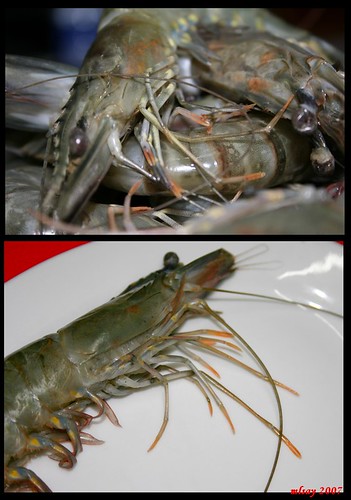 Growing up, my dad would teach us how to eat properly and one of this is how to peel shrimp without using your hands. Normally, as kids, we would just take off the head with our bare hands, peel off the shell and tail then pop it into our mouths after dipping it in some lemon butter or butter garlic sauce. (Yum.)
The kids would argue with him that there is no fun in eating shrimp with utensils. He would counter that it is best to learn how most specially when the time comes it may come in handy. So with displeasure we had to learn the art. Honestly, it was difficult at first and tiresome. We weren't able to eat as much as we wanted and the process took more time that we lost our appetite.
But that was many years ago. Now that we have mastered the art everything is just a cinch. Thank you dad for taking the patience in teaching us.
How to Peel Shrimps Using a Fork and Knife:
1) With a fork, pierce the part of the body near the head for a firm hold. The shrimp is now lying on it's side. Using your butter knife or dinner knife, decap the shrimp's head (the carapace).
2) Place the tip of the knife right on the legs and try to scrap off the legs (or the swimmerets). This will leave an opening and would make it easier to peel off.
3) Now pierce the fork where the swimmerets used to be.
4) Insert the tip of the knife in between the shrimps body and the shell. Push back the shell away from the body to a point that the shells would detach away from the body. Continue this until the shell have been taken out. The tail may be sliced off or peeled off.
I would say that practice makes perfect but nothing beats eating shrimp using your hands.
2007-11-06
Crusty Crustacean

Met up with dad at the San Francisco airport and headed to Red Lobster for lunch. Was it lunch or breakfast? I really can't tell anymore with the time difference and the long flight.
Upon entering, I was fascinated with the large tank filled with lobsters. I wanted to just grab them and see if they are as strong swimmers as Larry Lobster. If you do watch SpongeBob SquarePants, you would know which character I am referring to. If not, he is the lifeguard stationed at Goo Lagoon of Bikini Bottom. If not, probably ask if the saw Sebastian crawling in search for Princess Ariel. Kidding.
I remember the first time I had lobster. It was in Red Lobster too but in a different franchise. I told myself that I should have a taste before I head back home. So my aunt brought me and my mom to the nearest branch in Darien, Illinois. I had expectations that it would taste far different from Sebastian's kin, the crab. When I placed my order and tasted the first bite, I was suprise. It felt and tasted like a cross of white shrimps and king crabs. I guess I expected too much but then I shouldn't sell this crustacean short. I am sure there are other ways of preparing that will bring out its potential. I wonder if it would go well if it was prepared like the Chili Crabs of Singapore or cooked with rich coconut milk, ginger, finger chilis and leaves of swamp cabbage. Hmmmm yummy.
In writing this entry, I tried to search through the net for interesting tidbits about this decapod and found out that:
- Lobsters may outlive us. They are estimated to live up to 100 100 years (unless they were caught and cooked).
- Spiny lobsters gang up on their attacker by displaying their spines outward (their tails are pointing inward to bring out the spines).
- If a predator gets hold of one of the lobster's leg, the lobster casts of the limb, seals the area to avoid infection. The damaged leg will then regenerate or regrow producing a brand new one. Similar to their cousins the crabs. (Pretty neat. Wonder if they are distantly related to Wolverine by any chance :D )
- The largest lobster found weighed around 44 pounds, 6 ounces, 3 feet 6 inches from the end of tail fan to tip of largest claw.
- Lobsters are blue blooded. Not referring to royalty, but to the color of their blood. If iron makes the color of human blood turn red, copper makes lobster blood be blue.
- Lobsters may survive in storage without eating for a year if the shells are hard and are full of meat or reserves.
- The lobster capital of the world is located at Shediac, New Brunswick where the largest lobster sculpture is found.
- The age of a lobster is determined by its size and the hardness of the shell.
- Lobsters are actually red in color caused by a carotenoid pigment. Combined with protein, the pigment reacts and a the greenish-blue color which we naturally see on lobsters.
Subscribe to:
Posts (Atom)
LinkWithin
